

The Difference Between Original and Fake Perfumes – What Every Buyer Needs to Know
Millions of counterfeit fragrances reach consumers every year. Knowing what separates an authentic perfume from a fake one protects your health, your money, and your nose.
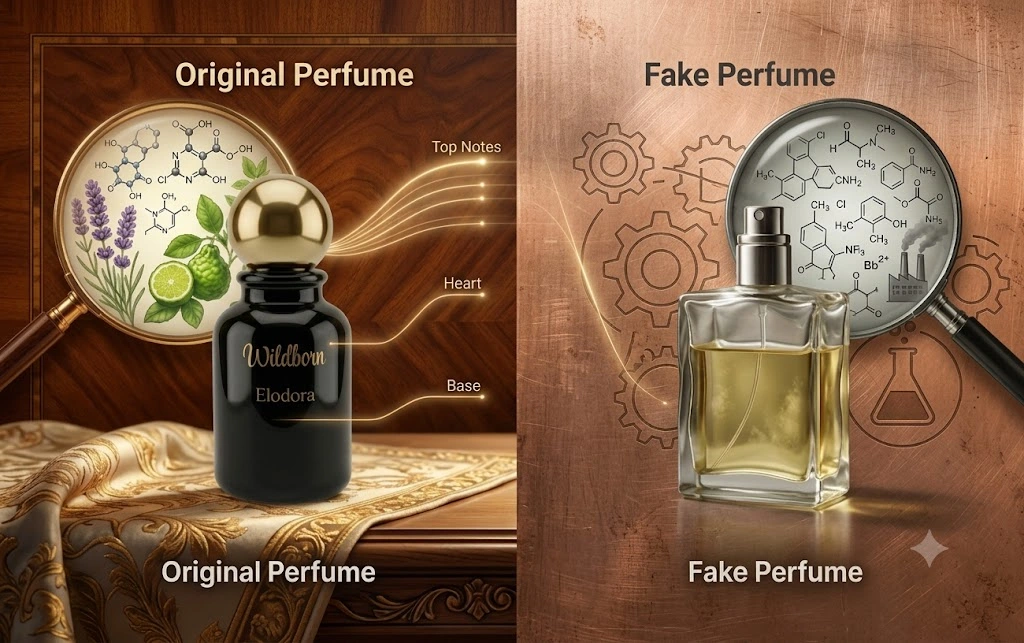
A fake perfume is not simply a cheaper version of the real thing; it is a chemically distinct product that often contains unlicensed synthetic compounds, unregulated alcohol substitutes, and none of the quality control that governs legitimate fragrance manufacturing. The difference between original and fake perfume is measurable across six distinct dimensions: packaging quality, fragrance performance, scent architecture, ingredient safety, authenticity markers, and price logic.
This guide covers every dimension in detail. By the end, you will be able to identify a counterfeit fragrance before you open the box and understand why the difference matters more than most buyers realize.
What Makes a Perfume “Original”?
An original perfume is a fragrance produced by a licensed manufacturer using registered formulas, regulated fragrance ingredients, and traceable production processes. Original perfumes carry batch codes, serial numbers, and, in the case of premium houses, barcodes that can be verified through third-party authenticity databases.
The International Fragrance Association (IFRA) governs the ingredients permitted in legitimate fragrances. IFRA compliance means the concentrations of potentially sensitizing ingredients are capped, regulated allergens are disclosed, and banned substances are absent from the formula. Every major fragrance house, including Dior, Gucci, Creed, and Chanel, submits formulations to IFRA for compliance assessment before market release.
Original perfumes are also distinguished by their concentration category. An Eau de Parfum (EDP) contains between 15% and 25% aromatic compounds, while an Eau de Toilette (EDT) contains 8% to 15%. These concentrations are not marketing language; they define the fragrance’s longevity, depth, and performance on skin. An original EDP lasts 6 to 12 hours; a genuine EDT lasts 4 to 7 hours. These performance metrics are formulated into the product and are not accidental.
“Original” does not always mean “designer.” A perfume brand can produce original, quality fragrances without being a luxury heritage house. What makes a perfume original is its authentic formulation, traceable production, and regulated ingredients, not its price tag or brand name.
What Is a Fake or Counterfeit Perfume?
A counterfeit perfume is a product manufactured to visually resemble an existing, recognized fragrance, typically a luxury brand, without authorization, quality control, or regulatory compliance. Counterfeit fragrances are produced in unlicensed facilities and sold using copied packaging, fake batch codes, and falsified labels.
Fake perfumes fall into three distinct categories:
- Outright Counterfeits: Bottles and packaging designed to pass as a specific designer brand (such as Dior, Chanel, or Versace) with no connection to the original manufacturer.
- Grey-Market Products: Genuine fragrances purchased in one country and resold in another without authorization. These are technically authentic but lack the authorized retailer’s warranty or return policy.
- Imitation Fragrances: Products openly sold as “similar to” or “type of” a well-known fragrance. These are not exact copies of a designer product; they are simply inspired by the same olfactory category.
⚠️ Important Distinction: Imitation fragrances sold honestly under their own brand name, without falsely claiming to be the designer original, are completely legal. They are not counterfeits. The problem with fake perfumes is not a similarity of character; it is fraudulent misrepresentation and unregulated ingredients.
The 7 Key Differences Between Original and Fake Perfume
These seven differences are observable, testable, and consistently distinguish authentic fragrances from counterfeits across every price category.
1. Packaging Quality and Print Precision
Original perfumes are packaged using premium-grade materials: heavyweight cardstock, smooth matte or gloss finishes, precisely die-cut closures, and print that is uniform, sharp, and free of smearing. The bottle itself, in a genuine fragrance, is made from weighted glass with uniform thickness and a precisely fitted cap that clicks or snaps with a consistent, firm action.
Counterfeit packaging reveals itself in the details. Uneven font weight, slightly blurred print edges, inconsistent spacing between characters, misaligned labels, and lightweight cardstock that bends under light pressure are all signs of low-quality reproduction. The bottle glass in a fake is often lighter, with visible bubbles in the glass or an inconsistent wall thickness. The spray nozzle on a counterfeit frequently misfires, sputters, or produces droplets rather than a fine mist.
Check the cellophane wrapping on a sealed fragrance: authentic packaging wraps tightly, with heat-sealed edges and no air pockets. Counterfeit cellophane is often looser, with uneven edges and visible folds.
2. Fragrance Longevity and Performance
Longevity is the most reliable performance marker separating original from fake perfume. An authentic EDP lasts 6 to 12 hours on skin because it contains a precise concentration of fixative molecules, such as musks, woods, and resins, that bind the aromatic compounds to the skin’s surface and slow their evaporation. A fake EDP may smell strong initially because it is loaded with cheap top-note synthetics, but it fades within 60 to 90 minutes because it contains no fixative base.
The sillage of an original fragrance, which is the trail it leaves in the air, evolves throughout the day. The top notes diffuse first, giving way to the heart, which in turn reveals the base. This three-phase progression is a structural feature of a properly formulated perfume. A fake fragrance has no such progression; it smells largely the same from application to fade because the cheap aromatic compounds it uses have similarly high volatility rates and no meaningful base accord.
The Wrist Test: Apply the fragrance to the inside of your wrist at 9 AM. Check it at 11 AM, 2 PM, and 5 PM. An original EDP will smell noticeably different at each check, evolving from fresh top notes to a warm, skin-close base. A fake will smell faint or identical at every check.
3. Scent Architecture: Notes, Drydown, and Evolution
Authentic fragrances are constructed using a note pyramid:
- Top Notes: The opening impression, lasting 15 to 30 minutes.
- Heart Notes: The core character of the fragrance, lasting 2 to 4 hours.
- Base Notes: The deep foundation, lasting 4 to 12+ hours.
Each tier uses aromatic compounds with different volatility rates, which is an intentional structural decision made by the master perfumer.
A fake fragrance does not follow this architecture. Because it is produced with the cheapest available synthetic compounds, all of which have similarly high volatility, the scent does not evolve. What you smell at first application is what you smell throughout its short wear time. There is no drydown, there is no base, and the fragrance simply fades away.
A trained nose can also detect the quality difference immediately. Original fragrances use high-grade synthetic molecules (like ambroxan, Iso E Super, and Hedione) alongside natural extracts. These materials have complex, multi-dimensional characters that smell slightly different at different temperatures, in different environments, and on different skin types. Cheap synthetic replacements smell flat, linear, and artificial.
4. Ingredients and Chemical Composition
Original fragrances are formulated to strict IFRA compliance standards. They list ingredients clearly on the outer packaging as required by EU regulations, disclose regulated allergens, and use carrier alcohols that are pharmaceutical-grade ethanol or high-quality denatured alcohol.
Counterfeit fragrances frequently substitute carrier alcohol with methanol, a toxic compound that causes skin irritation, headaches, and, in cases of significant exposure, systemic toxicity. Studies of confiscated counterfeit fragrances have found methanol concentrations exceeding safe limits alongside unapproved synthetic musks, unlisted allergens, and bacterial contamination from unsterilized production environments.
The color of the liquid is a secondary indicator. Original fragrances maintain consistent color across production batches because each batch uses identical formulation ratios. Counterfeit fragrances vary in color between batches and may appear more yellow, cloudier, or darker than the original product, which is visual evidence of inconsistent, uncontrolled mixing.
5. Batch Codes and Authenticity Markers
Every legitimate fragrance carries a batch code, which is an alphanumeric string stamped or printed on both the bottle and the outer box. This code encodes the production date, manufacturing facility, and batch number. Online batch-checking tools allow buyers to enter the batch code and verify the production date. If the code returns no result, or if the code on the bottle does not match the code on the box, the product is either fake or has had its code tampered with.
Premium fragrance houses embed additional authenticity features including holographic stickers, heat-reactive inks, micro-printed serial numbers, and QR codes linking to brand-specific verification pages. The absence of these features on a bottle claiming to be a luxury fragrance is a significant red flag.
The barcode printed on the packaging encodes the country of origin, manufacturer code, and product code. Scan the barcode with any barcode scanner app. If the product information returned does not match the product in your hand, the barcode has been falsified.
6. Price Logic
Genuine fragrances have consistent price floors. A 50ml Creed Aventus retails between £220 and £300 at authorized retailers in the UK. It does not retail at £25 at any time. If a product is offered at a price that seems implausible relative to the brand’s known retail range, the product is either counterfeit, diluted, or sourced from an unverified grey-market channel.
This does not mean that affordably priced fragrances are fake. Brands that formulate and sell their own original fragrances at accessible prices, using their own formulations under their own names, are entirely legitimate. The price logic test applies specifically when a product claims to be a named designer brand at a fraction of its known market price.
7. Point of Sale and Supply Chain
Authentic fragrances are sold through authorized retail channels: brand-owned boutiques, department stores, licensed online retailers, and the brand’s own website. Grey-market perfumes sold through unofficial channels, on generic marketplaces, or by street vendors carry no guarantee of authenticity regardless of how convincing the packaging appears.
Buying directly from the brand’s own website or an authorized retailer is the only way to guarantee product authenticity with certainty. When a brand sells directly online, as Elodora does at elodora.com, the product you receive is the exact product the brand manufactured, with no chain-of-custody risk.
How to Check If a Perfume Is Original
Follow this procedural sequence to verify the authenticity of any fragrance before and after purchase.
Examine the outer box under good light. The font should be uniformly sharp, the cardstock should resist gentle pressure without bending, and the cellophane should be taut with clean, heat-sealed edges.
Compare the batch code on the box with the batch code on the bottle. They must match exactly. Enter the code into a trusted online batch-checker to verify the production date.
Scan the barcode with a scanner app. Confirm that the digital product information returned matches the physical item in your hand.
Inspect the bottle glass against a light source. Authentic bottle glass is uniform in thickness and entirely free of bubbles. The cap should fit firmly with a consistent, solid click.
Test the spray action. A genuine atomizer produces a fine, even mist, whereas a counterfeit nozzle frequently produces heavy droplets, sputters, or misfires.
Apply the perfume to your skin and wait. Smell the wrist immediately after application for the top notes, at 30 minutes for the transition to the heart, and at 2 hours for the base notes. Note whether the scent dynamically evolves.
At the 6-hour mark, check whether the fragrance is still perceptible. A genuine EDP should still be detectable on the skin at this point, faded but clearly present.
Check the purchase source. Buying from an authorized retailer or a brand-direct website is the ultimate safeguard for product integrity.
Health Risks of Fake Perfumes
Counterfeit fragrances present measurable health risks that are well-documented in dermatological and toxicological literature. These risks do not apply to authentic, IFRA-compliant fragrances; they arise specifically from the unregulated ingredients present in counterfeits.
Can Fake Perfume Cause Eczema?
Yes. Counterfeit fragrances are a documented cause of allergic contact dermatitis, which is commonly referred to as eczema. The mechanism is straightforward: fake perfumes contain unregulated concentrations of fragrance allergens (such as eugenol, cinnamal, geraniol, and linalool) that trigger immune responses in sensitized skin.
IFRA compliance standards cap these allergens at concentrations below the threshold for sensitization in most adults. Counterfeit manufacturers use these compounds without any concentration controls.
Symptoms of contact dermatitis from fake perfume include redness, itching, and blistering at the application site (typically the wrists and neck), skin peeling in the days following application, and, with repeated exposure, a broadening of the reaction zone as the skin becomes increasingly sensitized. Individuals with pre-existing eczema, rosacea, or sensitive skin are at significantly higher risk.
If a fragrance causes any skin reaction, discontinue use immediately and consult a dermatologist. Always patch-test any new fragrance, even genuine ones, on your inner forearm before full application.
Does Perfume Affect the Thyroid?
Certain fragrance ingredients are classified as endocrine-disrupting compounds, which are chemicals capable of interfering with hormonal signaling, including thyroid function. The most commonly cited compounds in this context are synthetic musks (nitro musks and polycyclic musks) and phthalates used as plasticizers in fragrance packaging and delivery systems.
IFRA-compliant fragrances restrict or ban many of the most concerning synthetic musks based on their potential endocrine activity. Galaxolide and Tonalide, two widely used polycyclic musks, are subject to strict IFRA restrictions because bioaccumulation studies have shown them to persist in fatty tissue. Phthalates, particularly diethyl phthalate (DEP), are used in some EDT formulations as fixatives, but the EU Cosmetics Regulation highly restricts phthalate use in fragrance products.
Counterfeit fragrances are produced outside these regulatory frameworks. They may contain higher concentrations of restricted synthetic musks, unrestricted phthalates, or other endocrine-active compounds that have been completely banned in legitimate fragrance manufacturing. The cumulative risk of regular exposure to these compounds, particularly from products applied directly to skin twice daily, is a legitimate toxicological concern.
For individuals with known thyroid conditions or hormonal sensitivities, choosing IFRA-compliant fragrances from verified, regulated manufacturers is the appropriate precaution.
Key Takeaway: The thyroid and eczema risks associated with perfume in these contexts are almost entirely attributable to counterfeit and unregulated products. Legitimate, IFRA-compliant fragrances from reputable brands have an established safety profile. The risk lies in the counterfeit, not in fragrance itself.
The Critical Difference Between a Clone and a Fake
The words “clone,” “dupe,” “fake,” and “counterfeit” are often used interchangeably in casual conversation, but they describe very different concepts legally and practically.
| Category | Definition | Legal Status |
|---|---|---|
| Counterfeit / Fake | A product manufactured to impersonate a specific brand using copied logos, packaging, and brand names without authorization. The buyer is deceived into thinking they are buying the original brand. | ILLEGAL. Represents trademark infringement and consumer fraud. Subject to criminal prosecution in all jurisdictions. |
| Clone / Imitation | A fragrance with a similar olfactory character to a known fragrance, sold honestly under its own brand name without falsely claiming to be the original. The buyer knows exactly what they are buying. | LEGAL. No trademark infringement occurs if the brand name and logo are not copied. Regulated as a normal consumer product under IFRA and relevant cosmetics laws. |
| Grey Market | A genuine product purchased through unauthorized distribution channels, often imported from lower-cost markets. It is authentic but lacks the manufacturer’s local warranty. | LEGAL. The product itself is genuine, but the retailer is not explicitly authorized by the brand, which typically voids the local store warranty. |
When Elodora produces a perfume for women who love the character of Creed Carmina, or a perfume for men who love the bold freshness of Dior Sauvage, it is operating in the clone category, not the counterfeit category. Elodora fragrances are sold under the Elodora name, utilize Elodora’s own high-quality formulations, are manufactured to rigorous safety standards, and are never misrepresented as the designer original. This is a legal, legitimate, and transparent practice that has existed in the fragrance industry for over a century.
Read more about Elodora’s approach to original perfume
Buying Original Perfumes in Pakistan
Pakistan’s fragrance market presents specific authenticity challenges. Import duties on luxury goods make genuine designer fragrances expensive; a 50ml Dior Sauvage EDP typically retails between Rs. 22,000 and Rs. 35,000 through authorized channels. This price gap creates significant demand for counterfeit products, allowing fake fragrances to circulate widely through unofficial channels, Sunday markets, and grey-market online listings.
How to Buy Authentic Fragrance Online in Pakistan
- Buy Direct: Purchase from the brand’s own website. Brands that sell direct, as Elodora does, eliminate every chain-of-custody risk.
- Request Documentation: For designer fragrances, use only authorized import retailers and request to see the import permit or brand authorization certificate.
- Verify Before Opening: Check batch codes at checkfresh.com before accepting delivery of any sealed fragrance.
- Apply the Price Filter: Reject any fragrance offered at a price that seems implausible for the brand’s known retail range; price is always your first filter.
- Check the Returns: Look for clear return policies. Legitimate fragrance sellers offer structured return windows; counterfeit sellers rarely do.
Pakistani perfume brands that manufacture and sell their own original formulations under their own names, selling direct to the consumer through their own websites with clear pricing, batch traceability, and return policies, represent the most straightforward path to buying genuine fragrance at accessible prices.
Explore Elodora’s original perfume range starting from Rs. 4,000 for a 50ml EDP, formulated to international quality standards and shipped directly to your door.
Frequently Asked Questions
How do I check if a perfume is original or fake?
Check these five things in sequence:
- Examine packaging for sharp print quality, heavy card weight, and tight cellophane wrapping.
- Match the batch codes on the box and the bottle, then enter the code at checkfresh.com.
- Test the spray nozzle to ensure it produces a fine mist, not heavy droplets.
- Apply to skin and test longevity; a genuine EDP should last 6+ hours and evolve dynamically through top, heart, and base note stages.
- Verify the purchase source, sticking to authorized retailers and brand-direct websites.
What are the most common signs of a fake perfume?
The most reliable signs of a counterfeit fragrance are a scent that fades completely within 60 to 90 minutes of application; a linear smell that does not evolve through distinct note phases; packaging with uneven print, flimsy cardstock, or mismatched batch codes; a spray nozzle that drips or misfires; an unusually low price for a luxury brand; and purchase from an unauthorized or informal retail channel.
Does fake perfume affect the thyroid?
Counterfeit fragrances may contain unregulated concentrations of synthetic musks and phthalates, both of which are classified as potential endocrine-disrupting compounds. Repeated skin exposure to these ingredients in concentrations far above safety thresholds is a documented concern in toxicological literature. Legitimate, IFRA-compliant fragrances strictly restrict these compounds, meaning the safety risk is specific to counterfeit and unregulated products, not to fragrance in general.
Can fake perfume cause eczema?
Yes. Counterfeit fragrances often contain unregulated concentrations of fragrance allergens that trigger allergic contact dermatitis (eczema) in sensitized individuals. Symptoms include redness, itching, and blistering at the application site. IFRA-compliant fragrances cap allergen concentrations below these crystallization and sensitization thresholds. If a fragrance causes skin irritation, discontinue use immediately and consult a dermatologist.
Is it safe to buy clone or imitation fragrances?
A clone or imitation fragrance sold honestly under its own brand name, without falsely claiming to be the original designer product, is legal, regulated, and entirely safe if it is produced by a reputable manufacturer using compliant ingredients. The safety question applies to the manufacturer’s compliance standards, not to the existence of olfactory similarity with a known fragrance. Always verify the brand’s quality standards, check for ingredient transparency, and confirm that the product is sold under its own unique identity.
The Bottom Line
The difference between original and fake perfume is not merely a matter of branding; it is a matter of chemistry, safety, and transparency. Counterfeit fragrances contain unregulated ingredients, deliver no meaningful olfactory performance, and present documented health risks. Original fragrances, whether from heritage luxury houses or quality-focused independent brands, are formulated to consistent global standards, perform beautifully as described, and carry traceable authenticity markers.
Buying fragrance safely requires one consistent practice: know your source. A fragrance sold directly by its manufacturer under its own name, with clear pricing and reliable return policies, is the absolute definition of an authentic product, regardless of whether it is priced at Rs. 4,000 or Rs. 40,000.
Explore Elodora’s full range of original EDPs, all formulated to pristine quality standards, sold directly to you, with free shipping over Rs. 4,999 and a 10-day risk-free return policy.
About the Author
This article was compiled and written by the Elodora Fragrance Team, a collective of perfumers, fragrance educators, and specialists with direct experience in international fragrance formulation and the unique dynamics of the Pakistani fragrance market.


