

How Perfumes Are Made? From Raw Ingredients to Original Blended Fragrances
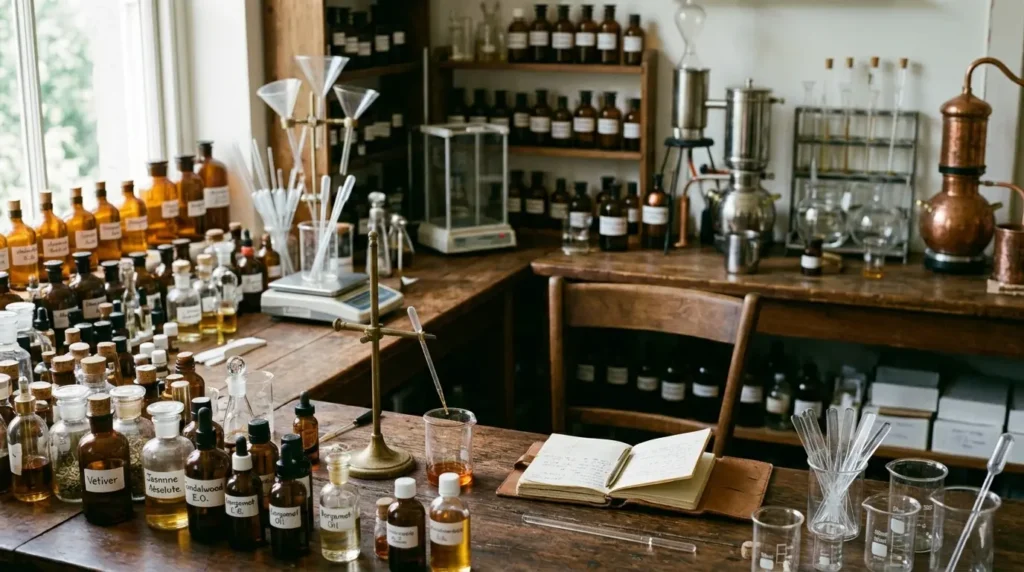
Perfume creation is a refined process that combines natural ingredients, scientific techniques, and artistic blending. Every fragrance is carefully developed through multiple stages, from extracting aromatic compounds to forming a balanced scent composition. A well-made perfume is not just mixed, it is designed to evolve over time, delivering a layered and long-lasting sensory experience.
What Are Perfumes Made Of?
All perfumes are built from three essential components:
- Fragrance oils – provide the actual scent
- Alcohol (or carrier) – helps the scent diffuse on skin
- Fixatives – stabilize the fragrance and improve longevity
These elements are combined into a structured formula that determines how a perfume smells, projects, and lasts.
If you’re new to perfume basics, read what perfume is and how it works
Step 1: Extracting Fragrance Ingredients
Before a perfume can be created, aromatic compounds must be extracted from raw materials such as flowers, woods, spices, and resins.
Common extraction methods include:
- Steam Distillation
- Uses steam to release essential oils from plants
- One of the oldest and most widely used methods
- Solvent Extraction
- Uses chemical solvents to extract delicate aromas
- Ideal for fragile flowers like jasmine
- Enfleurage (Traditional Method)
- Uses fats to absorb fragrance from petals
- Rare but historically important
- Cold Pressing
- Common for citrus oils
- Extracts aroma directly from peels
These methods determine the purity and quality of fragrance oils, which directly impact the final perfume.
Step 2: Creating the Fragrance Composition
Once ingredients are extracted, perfumers begin the most important stage, that is blending.
They combine different aromatic compounds to create a balanced scent composition, also known as an “accord.”
This stage defines:
- The identity of the fragrance
- Its complexity
- Its uniqueness
To understand how this structure works, explore fragrance notes and their layers
Step 3: Structuring the Fragrance Pyramid
Every perfume is organized into three layers:
- Top notes → first impression
- Middle notes → core identity
- Base notes → depth and longevity
This structure ensures the perfume evolves over time rather than smelling the same throughout.
Step 4: Aging and Maturation
After blending, the perfume is left to age and mature. This allows:
- Ingredients to fully integrate
- Harsh edges to smooth out
- The scent to become more balanced
High-quality perfumes often require time to reach their final form.
Step 5: Dilution and Concentration
The fragrance oil is then diluted with alcohol to create different perfume types:
- Eau de Toilette (EDT) → lighter concentration
- Eau de Parfum (EDP) → stronger and longer-lasting
- Parfum → highest concentration
This step directly affects longevity and projection.
Step 6: Filtration and Bottling
The final mixture is filtered to remove impurities and then bottled.
Packaging plays a key role in:
- Preserving the fragrance
- Reflecting brand identity
- Enhancing the luxury experience
Original Blending vs Replica Perfumes
Most users don’t realize this:
There are two completely different approaches in the market.
Replica / Impression Perfumes
- Copy existing designer fragrances
- Focus on similarity rather than creativity
- Often lack depth and refinement
Original Blended Perfumes
- Created from scratch
- Designed with unique compositions
- Offer distinctive scent identity
Elodora Advantage – Original Blended Perfumes
At Elodora, perfumes are not copied or replicated. Each fragrance is:
- Individually formulated using unique blends
- Created with carefully selected fragrance oils
- Designed for long-lasting performance and smooth transitions
This ensures every scent feels exclusive, refined, and authentic, crafted for individuals who value originality over imitation.
Explore Elodora original perfume collection
Why the Perfume-Making Process Matters
The quality of each step directly impacts:
- Longevity → how long the fragrance lasts
- Sillage → how far the scent projects
- Balance → smooth transition between notes
- Complexity → richness of the scent
A poorly made perfume may smell sharp, fade quickly, or lack depth.
Natural vs Synthetic Ingredients in Perfume
Modern perfumes use both:
- Natural ingredients → complex and rich
- Synthetic compounds → stable and consistent
A well-balanced perfume uses both to achieve:
- Stability
- Longevity
- Unique scent combinations
- From Creation to Skin Experience
Once applied, perfume interacts with your skin and environment. This is when the real effect of the blending process becomes noticeable.
To understand this transformation, learn how fragrance notes evolve over time
Experience True Perfume Craftsmanship
Perfume making is more than a technical process, it is an art of creating identity through scent. Original blended perfumes offer:
Authenticity
Depth
Long-lasting performance
Discover Elodora’s original perfume collection and experience true fragrance craftsmanship


